
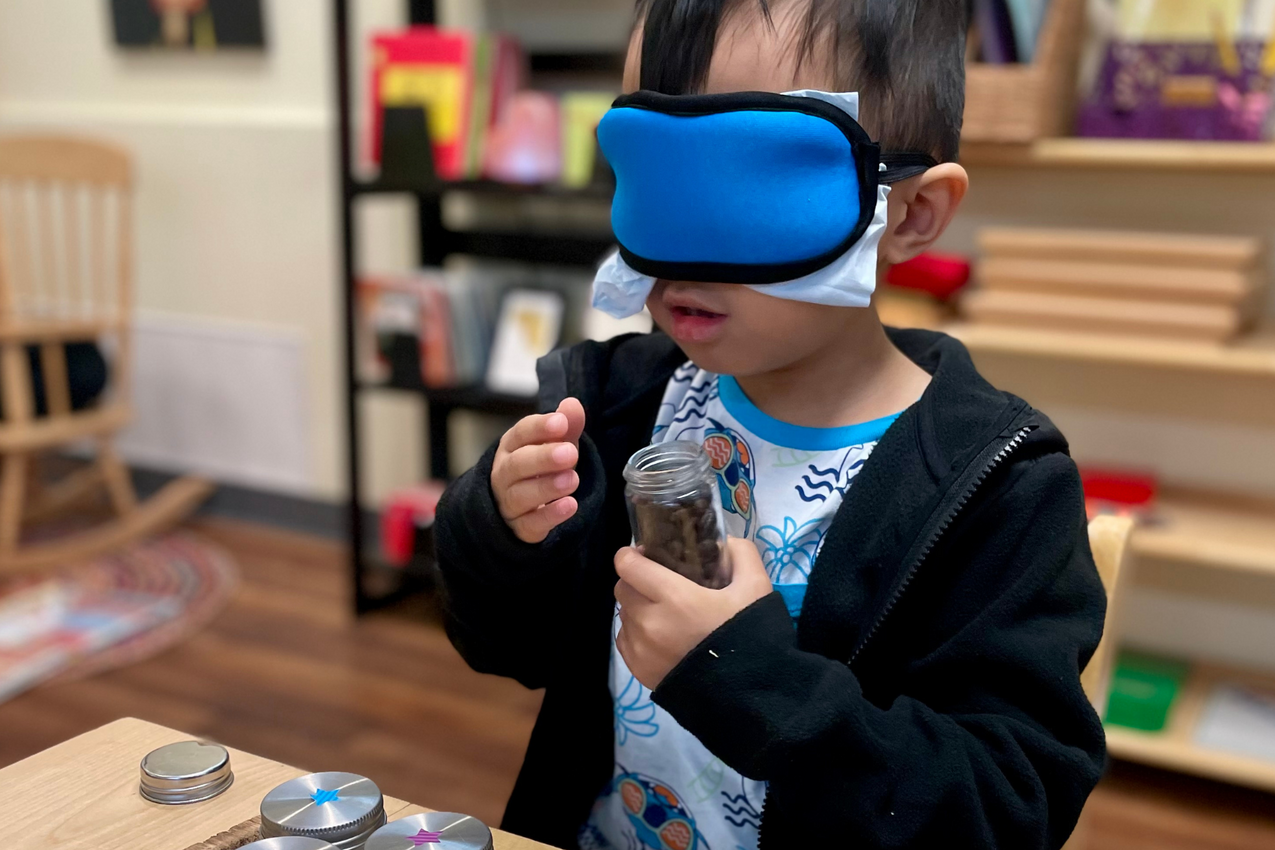
Awakening the Senses: Understanding the Montessori Sensorial Experience
One of the most fascinating aspects of the Montessori approach is the sensorial area of the classroom. While many parents are familiar with Montessori materials for reading, math, and practical life, the sensorial materials are sometimes less understood. Yet, they form the foundation for a child’s growing intelligence, creativity, and awareness of the world. In her 1949 book The Absorbent Mind, Dr. Maria Montessori wrote that she observed “The senses, being explorers of the world, open the way to knowledge.” Between the ages of 3 and 6, children are especially open to refining their senses—sight, touch, sound, smell, taste, and even the senses of weight, temperature, and spatial awareness.
Montessori noticed that the child’s mind naturally seeks to classify and organize the impressions it gathers from the environment. The sensorial materials of our classrooms provide concrete, hands-on experiences that allow children to compare, contrast, grade, and name their perceptions. For example, the Pink Tower invites the child to explore size and dimension, the Sound Cylinders isolate differences in volume, and the Color Tablets highlight distinctions in hue and shade. Each material isolates a single quality so the child can focus on it fully, and many of the materials are self-correcting, allowing the child to discover and refine understanding independently. In The Discovery of the Child, Montessori explained that “the training and sharpening of the senses has the obvious advantage of enlarging the field of perception and of offering an ever more solid foundation for intellectual growth.” Developing the senses is more than just a way to engage curiosity. Sensorial work prepares the intellect, strengthens observation skills, supports vocabulary development, and lays the groundwork for mathematical and scientific thinking. When a child learns to distinguish fine gradations in color or weight, they are not only refining their senses—they are also practicing the mental processes of classification, sequencing, and analysis.
Supporting Sensorial Exploration at Home
Parents often ask how they can extend their child’s Montessori activities beyond the classroom. Fortunately, the home and natural environment are rich with opportunities for sensorial development. Here are some ways to nurture your 3–6 year old’s senses in everyday life:
1. Encourage observation in nature
Take regular walks and invite your child to notice details: the different shades of green in leaves, the textures of bark, or the sounds of birds. Naming what they observe enriches vocabulary while sharpening their perception. Montessori reminded us, “the things he sees are not just remembered; they form a part of his soul.”
2. Offer kitchen experiences
Cooking and food preparation aren’t just for refining Practical Life skills; the kitchen can be filled with sensorial lessons, too. Let your child smell spices, taste a variety of fruits, and notice textures such as smooth bananas, crunchy carrots, or sticky dough. Invite them to compare flavors—sweet, salty, sour, bitter—and talk about their preferences.
3. Provide tactile materials
Young children love to touch and explore. Offer baskets with fabric swatches of different textures (silk, wool, cotton, burlap) or let them play with natural materials like sand, clay, and water. Matching or sorting activities with these textures mirror some of the classroom’s tactile exercises.
4. Listen closely together
Sound games help refine auditory discrimination. Sit quietly and ask: “What do you hear?”—a car passing, the hum of a refrigerator, a bird’s call. Play gentle listening games with instruments or everyday objects (shaking a jar of rice versus one with beans) to notice subtle differences.
5. Explore the sense of smell
Fill small containers with distinct scents—cinnamon, coffee, orange peel, lavender—and let your child smell and compare. This mirrors the classroom’s smelling jars and encourages awareness of an often-overlooked sense.
6. Give real vocabulary
One of Montessori’s key insights was the importance of precise language. When your child asks about a flower, instead of just saying “that’s a flower,” name it specifically, “that’s a marigold.” As Montessori said, “The aim of sensorial work is not to develop the senses, but to aid the child’s refinement of sense perception and to bring order into the myriad impressions he receives.” Naming brings clarity and order to what the child already perceives.
The sensorial materials in a Montessori classroom are scientifically designed tools to refine the senses, but the true goal of sensorial education extends beyond wooden blocks and cylinders. It is about cultivating a child who sees, hears, touches, tastes, and smells the world with heightened awareness. Montessori wrote, “The senses are organs for the apprehension of reality, and the development of the senses must therefore precede that of the higher intellectual faculties.”
At home, parents can support this by creating space for exploration, offering rich sensory experiences, and valuing their child’s natural curiosity. Through these simple but meaningful practices, you help your child not only enjoy the beauty of the world but also prepare their mind for the complex learning that lies ahead. As Dr. Montessori reminds us, “The child is the instrument through which nature accomplishes her purpose.” By nurturing your child’s sensorial experiences both in the classroom and at home, you are giving them the tools to discover the world with joy, precision, and wonder.
Written by Meagan Johnson, Western Hemlock Children's House Guide